Focus & Insights
Wildfire Smoke Is Back — And Your Outdoor Workers Are Breathing It
July 17, 2026
Canada is once again in the grip of a serious wildfire season, and the smoke is no longer someone else’s problem. According to the Canadian Interagency Forest Fire Centre, more than 830 wildfires are currently active across the country, with nearly 200 classified as out of control. The heaviest fire activity is concentrated in the Northwest Territories, Ontario, and Quebec — including dozens of uncontrolled fires burning in western Ontario alone.
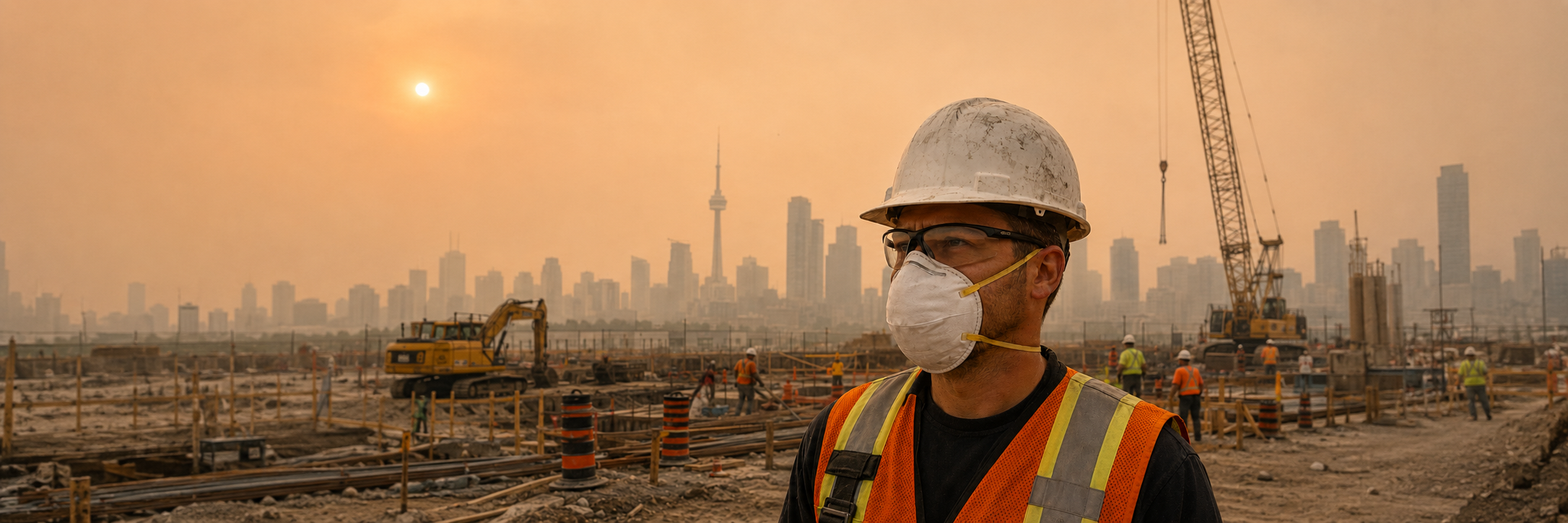
This week, thick smoke plumes drifted across the Great Lakes and down the eastern seaboard, pushing air quality into the “unhealthy” range for well over 100 million people across Canada and the northern United States. Skies over Toronto, Ottawa, Minneapolis, Boston, and New York turned hazy and yellow, and air quality alerts were issued across multiple provinces and states. Compounding the risk, a heat dome parked over central and eastern North America has driven humidex and heat index values into dangerous territory at exactly the same time — and Environment and Climate Change Canada is forecasting above-average temperatures through July and August.
For most people, the advice is simple: stay indoors, close the windows, limit exertion. But hundreds of thousands of Canadians don’t have that option. Construction crews, roofers, landscapers, utility linemen, road builders, municipal workers, agricultural workers, and outdoor maintenance teams are still on the job — often doing heavy physical work, outdoors, for full shifts.
What Wildfire Smoke Does to Workers
Wildfire smoke is a complex mixture, but the primary health concern is fine particulate matter — PM2.5. These particles are small enough to bypass the body’s natural defences, penetrate deep into the lungs, and enter the bloodstream. Short-term exposure causes eye and throat irritation, coughing, headaches, and reduced lung function. For workers with asthma, COPD, or cardiovascular conditions, it can trigger serious health events. Repeated exposure over multiple fire seasons raises longer-term respiratory and cardiovascular risks.
The occupational problem is that exposure scales with breathing rate. A worker doing strenuous physical labour outdoors can inhale several times the volume of air — and several times the particulate dose — of someone at rest. An Air Quality Health Index reading that suggests “reduce strenuous activity” for the general public can represent a significant occupational exposure for someone swinging a hammer or running a shovel for ten hours.
And this summer, smoke isn’t arriving alone. Heat stress and wildfire smoke are compounding hazards: heat drives up respiration rates and cardiovascular strain, while some forms of respiratory protection can add to thermal load. Managing one hazard without accounting for the other can make things worse.
The Employer’s Duty Doesn’t Pause for Smoke
Under Canadian occupational health and safety legislation, employers have a general duty to take every precaution reasonable in the circumstances to protect workers — and that duty extends to environmental hazards like wildfire smoke. “It was smoky everywhere” is not a due diligence defence. Practical measures employers should be taking right now include:
Monitor air quality actively
Track the Air Quality Health Index (AQHI) and local special air quality statements for every work location, not just head office. Conditions can change hour to hour as wind shifts.
Set exposure-based work triggers
Define in advance what happens at each AQHI level: when strenuous tasks get rescheduled, when work-rest cycles change, when respiratory protection becomes mandatory, and when outdoor work stops.
Get respiratory protection right
Dust masks and surgical masks do not protect against PM2.5. Effective protection requires properly selected and fit-tested respirators (such as N95 or better), supported by a written respiratory protection program consistent with CSA Z94.4 — including medical screening, training, and fit-testing.
Identify vulnerable workers
Workers with pre-existing respiratory or cardiac conditions, and those who are pregnant, face elevated risk and may need modified duties on high-smoke days.
Manage heat and smoke together
Adjust schedules toward cooler, lower-smoke parts of the day, increase rest breaks in clean-air rest areas (air-conditioned trailers or vehicles with recirculated, filtered air), and ensure hydration protocols are in place.
Document everything
Air quality readings, decisions made, controls implemented, and training delivered. If a worker files an occupational disease claim years from now, this record is your evidence of due diligence.
Know What Your Workers Are Actually Breathing
The hard truth is that most organizations are guessing. They don’t have baseline exposure data, they’re relying on regional AQHI readings rather than site-specific measurements, and their respiratory protection decisions aren’t grounded in actual hazard characterization. Wildfire smoke season is exposing a gap that exists year-round.
This is precisely the problem occupational hygiene exists to solve. CrossSafety’s Occupational & Industrial Hygiene Services apply the science of anticipation, recognition, evaluation, and control to protect workers from health hazards at the source — including the airborne particulate, heat stress, and respiratory protection challenges this fire season is putting front and centre.
Our certified occupational and industrial hygienists (CIH, COH, ROH) can support your organization with:
- Workplace exposure assessments — personal and area air sampling for particulates, analyzed through AIHA-accredited laboratories and reported against applicable Occupational Exposure Limits, ACGIH TLVs®, and provincial regulations, so your decisions are based on data, not assumptions.
- Respiratory protection program development — hazard characterization, respirator selection, fit-test coordination, user training, and written programs aligned with CSA Z94.4.
- Heat stress assessment — evaluation of physical stressors, including combined heat-and-smoke work environments, with practical control recommendations.
- Regulatory compliance documentation — the monitoring records and written programs that demonstrate due diligence to regulators, insurers, and adjudicators.
Wildfire seasons like this one are no longer rare events — they’re a recurring feature of the Canadian summer, and employers who treat smoke as a predictable, manageable occupational hazard will protect their people and their organizations. Those who treat it as bad weather will keep getting caught off guard.
Don’t wait for the next smoke advisory to find out what your workers are breathing. Contact CrossSafety to speak with our occupational hygiene team, or call 888-732-4347.
Latest News & Insights
Deeper Dives
Uncategorized
Occupational Hygiene: A Practical Guide to Identifying and Controlling Workplace Health Hazards
Focus & Insights
Workplace Noise Assessment and When You Need One
Focus & Insights
Silica Exposure and How to Control the Risk