
Focus & Insights
When a Drone Takes a Dive: Lessons from the Coxwell Bypass Tunnel Confined Space Inspection
A confined space inspection got interesting when our drone went off script. Here’s the story, the lessons, and how it helped move the Coxwell Tunnel project forward.
In complex infrastructure projects, even the simplest tasks can turn into memorable stories — especially when technology meets the unpredictable reality of a confined space.
Recently, during early work on the Coxwell Bypass Tunnel Project, our team began the project with a straightforward goal: confirm that the drawings matched actual site conditions before any major work proceeded. To speed up this initial review, the plan was to deploy a small drone through an access hatch and perform a confined space inspection of the bypass tunnel.
And while the mission did give us the information we needed… it also gave us a few unplanned surprises.
Phase 1: A Smooth Start (Mostly)
With the access shaft opened and the drone initialized, our operator prepared to guide the aircraft through the narrow opening. The proximity sensors were disabled — a step for tight-entry drone work — and the drone began its descent.
But tunnels have personalities of their own.
As soon as the drone cleared the shaft walls, it met a strong upward draft created by differences in air pressure within the bypass tunnel. The drone wobbled, corrected, and then stabilized — exactly what an experienced pilot expects in an unpredictable confined space environment.
Once inside, the drone performed beautifully.
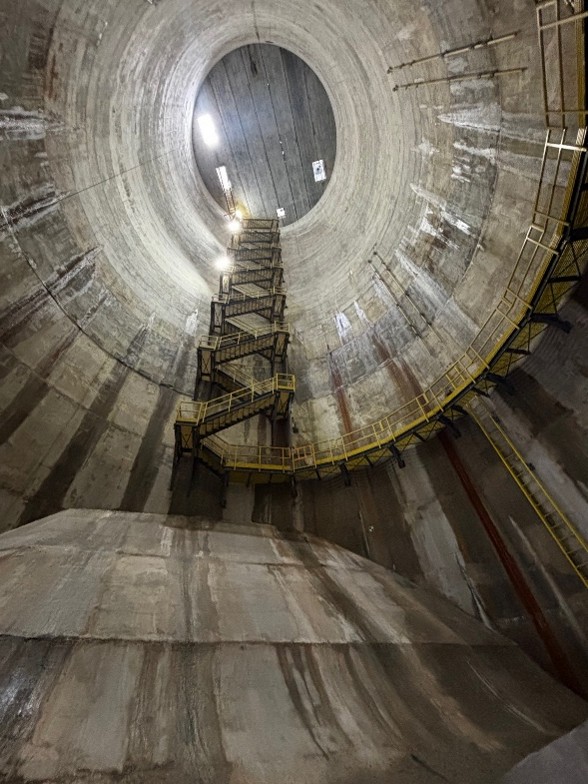
It captured clear overhead visuals of:
- The tunnel interior
- The stairwell
- Entrance points
- Structural features requiring verification
Everything aligned with the project drawings. Mission accomplished… or so we thought.
Phase 2: The Great Escape Attempt
With the inspection complete, the drone was guided back toward the access shaft for retrieval.
That’s when things got interesting.
As the drone lifted and turned, the upward draft returned — pushing it off its intended path and nudging it toward the stairwell. The pilot attempted to correct course, but in tight spaces, overcorrection can quickly become overreaction.
Tap.
Scrape.
Whump.
The drone made contact with the stairwell, clipped an edge, and tumbled to the ground.
The good news?
It missed a flowing trickle of water below (likely sewer runoff).
The bad news?
Even through the onboard camera still worked, capturing a final low-angle shot of its resting place, the drone itself wasn’t going anywhere. Its motors responded, but the damaged rotor arm and missing propeller meant it couldn’t take off.
Phase 3: CrossSafety Steps In
Two days later, our Confined Space team entered the tunnel to complete the inspection manually and recover the drone.
What we found:
- One broken rotor arm
- One missing propeller
- A non-functional gimbal
- A drone that looked like it had learned a valuable life lesson
Despite its rough landing, the drone did achieve the primary objective — confirming that structural conditions matched the plans and allowing the project team to move forward confidently.
What This Teaches Us About Confined Space Work
This incident — equal parts amusing and educational — highlights a few important truths about confined space inspection:
1. Drone technology is a powerful tool, but not a replacement for trained personnel.
Even the best equipment can be affected by drafts, turbulence, or spatial constraints.
2. Confined spaces behave unpredictably.
Air movement, geometry, and even minor variations in pressure can influence equipment performance.
3. Planning, supervision, and standby capability are essential.
Whether deploying a drone or sending in workers, having a qualified confined space support team ensures safe, controlled operations.
From Drones to Rescue Teams — CrossSafety Has You Covered
While the drone may not have survived unscathed, its mission helped accelerate early decision-making on the Coxwell Bypass Tunnel Project. And when the recovery — and final inspection — required human expertise, our Confined Space specialists ensured it was completed safely and efficiently.
From confined space inspections to attendant support to rescue standby services, CrossSafety provides the personnel, systems, and experience required to manage high-risk environments with confidence.
Because in confined spaces, even the simplest tasks can become complex — and that’s exactly why having the right team matters.
Contact CrossSafety to plan your next confined-space project or speak with our Specialized HSE Consulting experts.
Latest News & Insights
Focus & Insights
Know the Risk, Control the Risk: Asbestos Awareness Training
Focus & Insights
Accounting Specialists: We’re Hiring in Markham
Focus & Insights
Know the Risk, Control the Risk: Asbestos Awareness Training